Last Updated: January 2026
Bottom Line Up Front (BLUF):
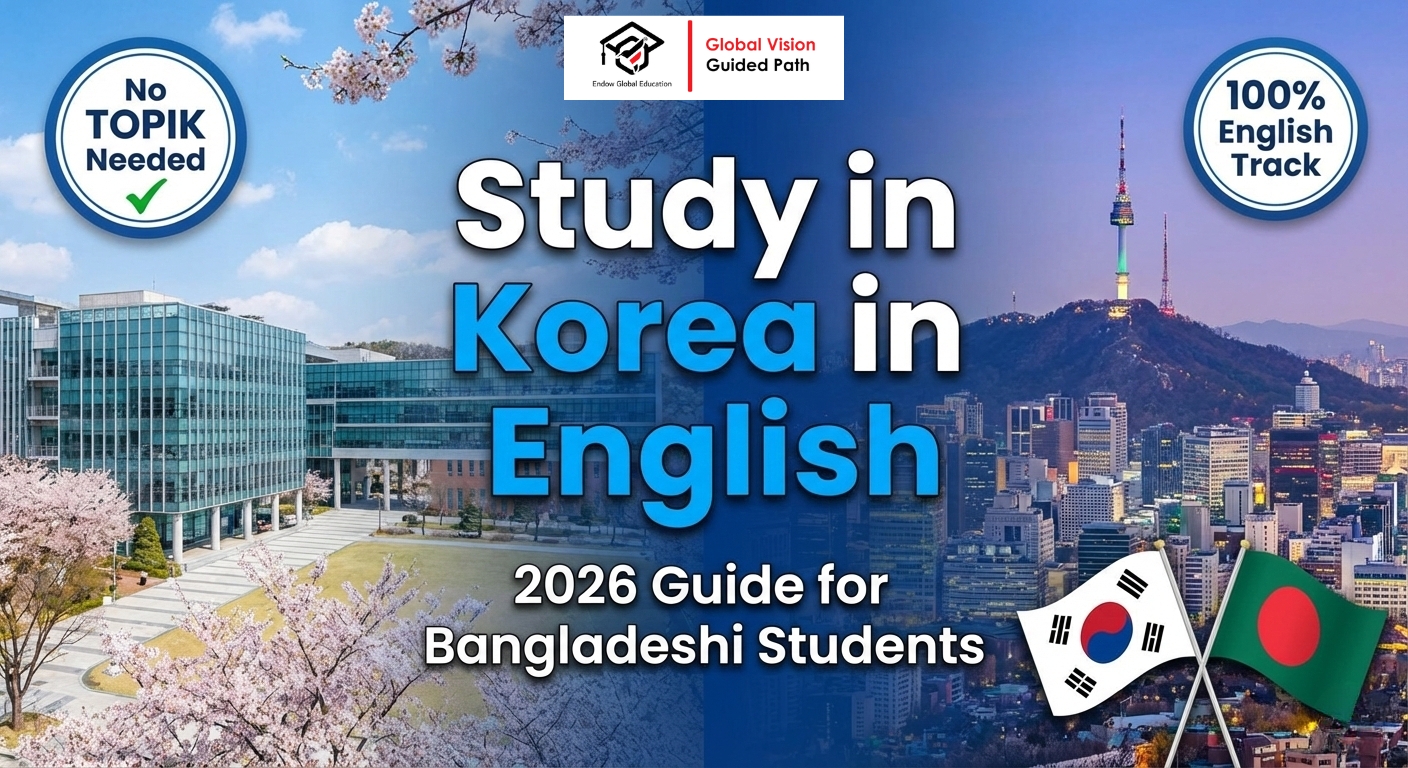
Yes, you can complete a full Bachelor’s or Master’s degree in South Korea 100% in English. You do not need a TOPIK (Korean proficiency) score for admission to these specific tracks. However, you must provide an English proficiency score (IELTS 5.5 – 6.5+) or, in rare cases, a “Medium of Instruction” certificate from your Bangladeshi university.
1. Top 5 “English Track” Universities for Bangladeshis
These universities are the most popular among Bangladeshi applicants because they offer dedicated international colleges where all classes are in English.
| University | Program / College | Best For… | Location | Scholarship Chance |
| Yonsei University | Underwood Int. College (UIC) | Liberal Arts, Biz, Econ | Seoul | Medium |
| Korea University | Div. of Int. Studies (DIS) | Int. Relations, Commerce | Seoul | Medium |
| KAIST | All Engineering Depts. | CS, AI, Mech. Eng | Daejeon | High (Full Ride) |
| UNIST | All Engineering Depts. | Engineering, Science | Ulsan | High (Full Ride) |
| SolBridge | Int. School of Business | BBA, MBA, Marketing | Daejeon | High (Partial) |
Pro Tip for Bangladeshi Students: KAIST and UNIST are STEM-focused. If you are from BUET, DU, or SUST with a high CGPA, these should be your top targets because they offer full scholarships + monthly stipends automatically upon admission.
2. Admission Requirements (No Korean Needed)
To apply for these tracks, you skip the Korean language exam (TOPIK) and submit English proof instead.
- IELTS / TOEFL:
- Minimum: IELTS 5.5 is the technical minimum for many private unis.
- Recommended: IELTS 6.5 or 7.0 is safe for visa processing at the Korean Embassy in Dhaka.
- Academic Records:
- Undergrad: SSC/HSC transcripts (Apostilled/Attested by MoFA).
- Grad: Bachelor’s Certificate & Marksheets.
- Bank Solvency:
- You must show proof of funds (approx. $20,000 USD or 24 Lakh BDT) in a bank account under your name or your parents’.
- Note: KAIST/UNIST often waive this because their scholarship covers everything, but you still need a nominal amount for the visa.
3. The “GSIS” Cheat Code for Masters Students
If you are a Humanities/Social Science student (from DU, NSU, BUP, etc.), you should target GSIS (Graduate School of International Studies).
- What is it? A specialized graduate school found in top universities (SNU, Yonsei, Korea, Sogang, Ewha).
- Why it works: The entire curriculum is designed for foreigners and diplomats.
- Language: 100% English.
- Networking: High chance of meeting international diplomats and MNC recruiters.
4. Pros & Cons of English Tracks
| Pros (The Good) | Cons (The Reality) |
| No need to spend 1-2 years learning Korean before starting your degree. | You will struggle in daily life (banking, grocery, hospitals) without basic Korean. |
| You study with international professors and students. | Your social circle might be limited to other foreigners. |
| Textbooks and assignments are standard global editions. | Part-time jobs (Baiteu) are harder to find if you don’t speak Korean. |
5. FAQ: English Track Specifics
Q: Can I apply with a “Medium of Instruction” (MOI) certificate from my Bangladeshi university?
A: Technically yes, but risky. Some universities accept it, but the Korean Embassy in Dhaka strongly prefers IELTS for the visa interview. A solid IELTS score (6.0+) is your safety net against visa rejection.
Q: Is it expensive?
A: Private Universities (Yonsei, Korea): Expensive (~$5,000/semester). You need a scholarship (GKS or University Merit Scholarship).
National/Tech Unis (KAIST, UNIST): If admitted, tuition is usually free.
Q: Can I stay in Korea after graduation?
A: Yes. You can switch to a D-10 (Job Seeker) Visa. However, to get a corporate job in Korea later, you will eventually need to learn Korean (TOPIK 4+).